

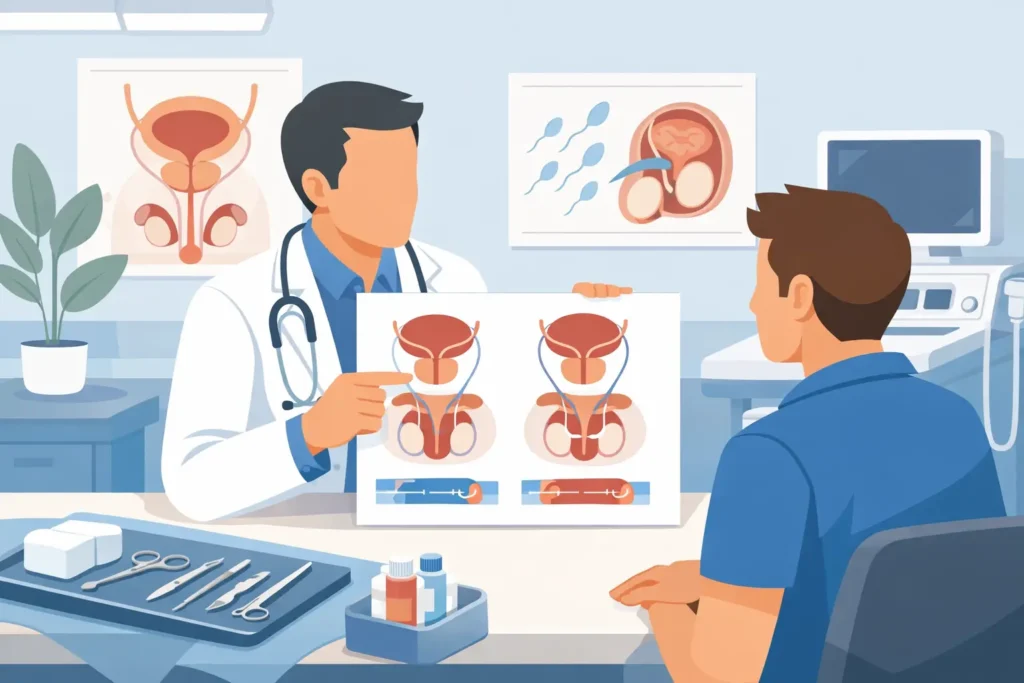
A vasectomy is a small procedure, but the details matter when you are choosing who will perform it. One question patients sometimes encounter is open-ended versus closed vasectomy. The names sound technical, yet they describe one specific part of the operation: what is done with the testicular end of the vas deferens after it has been divided.
For most men, both approaches can provide reliable permanent contraception when performed carefully and followed by the required semen testing. The right discussion is not about chasing a fashionable label. It is about understanding the technique, the experience of the clinician, and what happens if you need advice during recovery.
What happens during a vasectomy?
The vas deferens are the two small tubes that carry sperm from the testicles towards the penis. A vasectomy works by interrupting these tubes, so sperm can no longer join the semen that is ejaculated.
The testicles continue to produce testosterone and sperm after a vasectomy. Testosterone still enters the bloodstream as normal, so a vasectomy does not reduce masculinity, alter erections, lower libido or change the sensation of orgasm. Semen still looks much the same because sperm make up only a small proportion of its volume.
A modern no-scalpel procedure uses a very small opening in the skin of the scrotum to reach the vas deferens. This is separate from whether the operation is open-ended or closed. No-scalpel refers to access through the skin; open-ended and closed refer to how the divided tube is managed.
Open-ended versus closed vasectomy: the key difference
Each vas deferens has two ends after it is divided. The abdominal end leads towards the prostate and penis. The testicular end leads back towards the testicle, where sperm are made.
Closed vasectomy
In a closed vasectomy, both ends of the divided vas are sealed. Depending on the clinician’s technique, this may involve cautery, clips, ties (stitches) or a combination of methods. The aim is to create a secure blockage between sperm production and ejaculation. The traditional “ligation excision” vasectomy carried out by Urologists uses this method. Basically, the vas is secured, an incision is made into the vas over each side, a piece of suture material is tied around each end of the vas and a piece of vas is removed. Some surgeons double back the upper end of the vas to avoid reconnection and stitch the upper end back to the vas.
Because the testicular end is closed, sperm produced in the testicle have no easy route into the divided vas. However, there are still microscopic openings and a sperm granuloma on the lower end is still possible. Whatever happens, the body naturally breaks down and reabsorbs sperm over time. This is a normal process, but it is believed the potentially higher amount of postoperative pain in close ended procedures may be due to the pressure within the system that rises temporarily in some men. It could also be due to spasm in the vas with the accumulation of more sperm at the end where it cannot escape.
Open-ended vasectomy
In an open-ended vasectomy, the abdominal end is sealed to prevent sperm reaching the semen, while the testicular end is deliberately left open. The theory is that this may allow sperm and fluid to escape into surrounding tissues, where they are absorbed by the body, rather than building up pressure behind a sealed end. Some surgeons believe this is best achieved with a fresh vas left open. I am not so sure as fresh tissue has even higher healing potential to close itself. I believe this is best achieved with the so called “banana split” method and external cautery to the vas.
The sealed abdominal end still needs to be managed securely. Experienced clinicians commonly use cautery and some place tissue between the two ends, known as fascial interposition, to reduce the chance that they reconnect. Facial interposition is common in the US, but less common in the UK. Fascial interposition is usually achieved with a titanium clip and less commonly using a suture. Some doctors, including Dr Kittel believe this has a higher potential to cause chronic post vasectomy pain.
Does an open-ended vasectomy hurt less?
This is usually the main reason men ask about the difference. Open-ended vasectomy was developed partly to reduce pressure-related discomfort after the procedure, including congestion in the epididymis, the structure at the back of the testicle where sperm mature.
Some clinical evidence and long-standing specialist experience suggest that leaving the testicular end open may reduce certain forms of post-vasectomy discomfort. However, it is not a guarantee of a pain-free recovery, and it does not mean that every closed vasectomy causes problems. Most men recover without significant long-term pain whichever established technique is used.
Short-term tenderness, bruising, swelling and a pulling sensation are common after any vasectomy. These usually settle with rest, supportive underwear and simple pain relief if suitable for you. A small number of men develop a tender sperm granuloma, a small lump caused by sperm leaking into nearby tissue. It is often harmless and settles, but should be assessed if it is painful, enlarging or worrying you.
Chronic testicular or scrotal pain after vasectomy is uncommon, but it is a recognised risk and should be discussed before treatment. It can occur after either technique and has more than one possible cause. A careful consultation should cover this honestly rather than presenting one approach as entirely risk-free. The AUA guidance quotes figures of 1-2% chronic pain for US patients. The UK ASPC audit of > 100,000 patients only shows approximately 1:500 – 1:700 patients with chronic pain for the UK method.
Is open-ended vasectomy as effective?
Yes, even more so. Ligation excision is know to have significantly higher failure rates than a No scalpel vasectomy. It is be highly effective when the abdominal end is securely sealed and the procedure is performed to a minimally invasive standard using cautery and a reasonably interruption length or fascial interposition or both. But no vasectomy should be considered successful immediately after the operation.
Sperm can remain beyond the point of blockage for weeks or months. You must continue using contraception until a semen sample confirms that it is safe to stop. This is not an optional administrative step. It is how the result of your individual procedure is confirmed.
The timing and number of samples required can vary according to the clinic’s protocol and the result obtained. Occasionally, a further sample is needed. Rarely, sperm continue to be present or the vas reconnects. In that situation, a repeat procedure may be advised.
Technique is only one part of reliability. Good identification of both vas deferens, effective occlusion, clear laboratory follow-up and a straightforward route back to the clinic if there is a concern all contribute to a dependable service.
What recovery is like with either technique
For the patient, the day-to-day recovery is usually very similar whether the vasectomy is open-ended or closed. The procedure is normally carried out under local anaesthetic, meaning you are awake but the area is numbed. You may feel movement or brief pressure, but should not feel sharp pain.
Plan for a quiet day afterwards and avoid driving yourself home. Most men return to desk-based work within a couple of days, although physical jobs may require more time. Avoid heavy lifting, gym sessions, cycling and sport until you are comfortable and have followed your clinician’s specific advice. Supportive pants can make the first few days more comfortable.
Sex can usually resume when you feel comfortable, but contraception remains essential until semen testing gives clearance. The operation does not work straight away.
Contact your clinic promptly if you develop worsening pain, marked swelling, bleeding that does not settle, a fever, spreading redness, discharge from the wound or anything that feels out of proportion to the expected recovery. Reassurance is useful, but timely assessment is better when something does not feel right.
Which technique should you choose?
It is reasonable to ask whether your clinician performs open-ended or closed vasectomy, and how they seal the abdominal end. It is also reasonable to ask how many procedures they perform, what follow-up is included and what happens if your semen test does not clear.
The best choice is not always determined by technique alone. Your anatomy, medical history, previous scrotal surgery, medication and level of anxiety can all affect how the procedure should be planned. Men taking certain blood-thinning medicines, those with difficult-to-locate vas deferens, and those declined elsewhere may benefit from assessment by a clinician who performs vasectomy regularly.
At Thames Valley Vasectomy Services, the procedure uses an open-ended, no-scalpel, stitch-free approach. That combination is designed to keep the procedure focused and recovery straightforward, while recognising that every patient still deserves individual advice and proper follow-up.
Questions worth asking at your consultation
A good consultation should leave you clear on more than the name of the technique. Ask how the vas deferens will be sealed, whether the procedure is no-scalpel, how discomfort is managed, when you can return to work and exercise, and exactly when and how to provide your semen sample.
You should also discuss permanence. Vasectomy should be chosen only when you are confident you do not want to father children in future. Reversal can sometimes be attempted, but it is more complex, more expensive and cannot be guaranteed. If you feel uncertain, taking more time is the right decision.
The most reassuring vasectomy is one where you understand the plan, know how to reach the team afterwards and do not feel rushed into a choice. Ask the questions that matter to you, then choose a service that answers them plainly.