

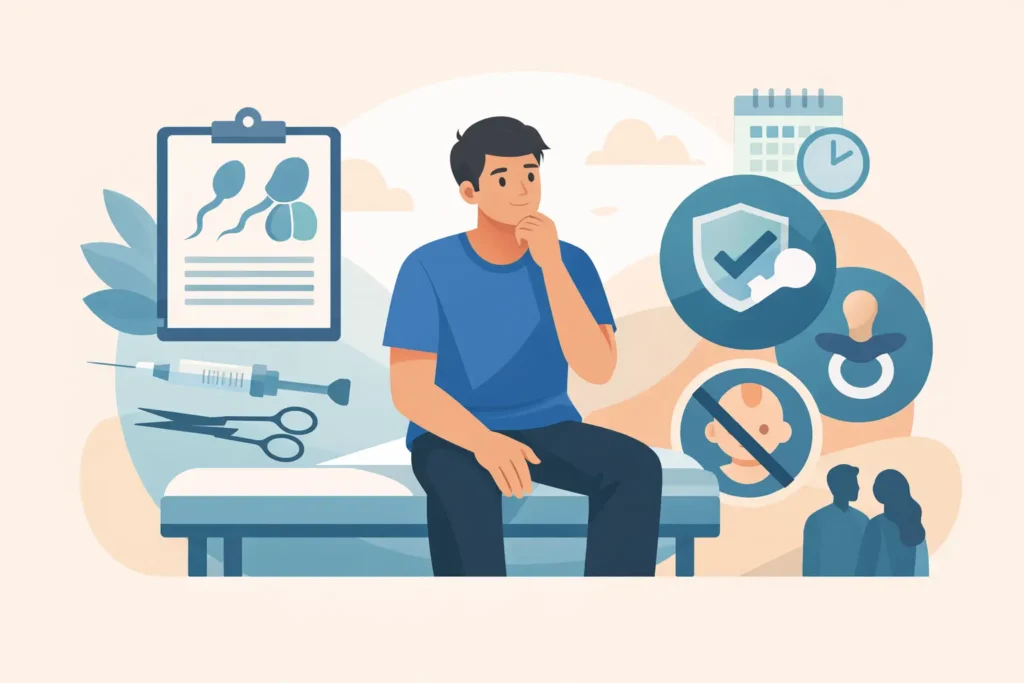
Being certain that you do not want children can be a clear, settled feeling at 25, 28 or 29. Yet when people ask about vasectomy consent under 30, they are often worried that their age alone will mean they are dismissed, judged or unable to proceed. That should not be the starting point. A good consultation considers you as an individual: your understanding of permanent contraception, your circumstances, your reasons and whether your decision feels genuinely your own.
A vasectomy is intended to be permanent. That is why clinicians take consent seriously at every age, but may explore the decision in more detail with younger patients. This is not about telling you how to live your life. It is about making sure that you have had the time, information and space to make a decision you are comfortable with for the long term.
Vasectomy consent under 30: why age can prompt more discussion
In the UK, an adult with the capacity to understand, retain and weigh up relevant information can consent to medical treatment. There is no single legal rule saying that a man under 30 cannot have a vasectomy.
However, age can be relevant to a clinician’s assessment of future regret. People’s relationships, health, finances and views about parenthood can change over time. Research and clinical experience suggest that regret is more likely in some circumstances, including when someone is younger, has no children, is going through a difficult relationship period or feels pressure from somebody else. More likely does not mean inevitable. It simply means these are sensible areas to discuss properly.
Some providers have their own policies for younger patients, such as allowing additional reflection time or arranging a further consultation. Others may decide not to offer the procedure in particular circumstances. If that happens, it is reasonable to ask why, what information would help them assess your case, and whether a consultation with an experienced vasectomy specialist would be appropriate.
The purpose should be a thoughtful conversation, not a test you have to pass by giving the “right” answers.
What informed consent actually means
Consent is more than signing a form on the day. It is a process that gives you enough clear information to decide freely whether vasectomy is right for you.
Understanding permanence and reversal
A vasectomy prevents sperm from joining semen by dividing and sealing the vas deferens, the tubes that carry sperm. It is among the most effective forms of contraception once post-procedure testing has confirmed success.
The key point is that it should be chosen as permanent contraception. Vasectomy reversal is sometimes possible, but it is more complex surgery, is not routinely available on the NHS and cannot be guaranteed to restore fertility. Success depends on factors including the time since vasectomy and the techniques used. It should never be treated as a dependable back-up plan.
If the possibility of biological children later feels significant, sperm storage before vasectomy is an option some people consider. It involves its own cost, arrangements and no guarantee of a future pregnancy, but it may be worth discussing before making a permanent decision.
Knowing the alternatives
A clinician should also cover reasonable alternatives. These may include condoms, a partner’s contraception, long-acting reversible contraception for a partner, or simply waiting if you are uncertain. The best option depends on your relationship, health, preferences and whether you want a method that is permanent.
It is also useful to be clear about what vasectomy does not do. It does not protect against sexually transmitted infections, and it does not work immediately. You must continue using contraception until a semen test confirms that the procedure has been successful.
Making the decision freely
Your partner can be part of the conversation if you want them to be, particularly if it would help you talk through practical matters and future plans. But a partner does not legally consent on your behalf, and you do not need anyone else’s permission to have a vasectomy.
Equally, it should not be something you choose because a partner, family member or friend is pushing you towards it. If you feel under pressure, tell the clinical team. A private conversation is part of good care, and it allows you to speak honestly without having to manage somebody else’s expectations.
What a consultation may cover
An experienced vasectomy consultation is usually practical rather than intimidating. You may be asked about your medical history, medication, previous groin or scrotal surgery, allergies and whether you have had any issues with bleeding. Certain blood-thinning medicines and more complex anatomy do not automatically rule out treatment, but they need careful planning.
For a younger patient, the consultation may also explore how long you have considered vasectomy, whether your view has been consistent, your current relationship circumstances and how you would feel if those circumstances changed. There is no requirement to have children, to be married or to reach a particular stage of life. The relevant issue is whether you understand the permanence of the procedure and are making a settled, informed decision.
You should also receive a straightforward explanation of the procedure itself, recovery and possible complications. A no-scalpel, stitch-free approach generally involves a small opening in the scrotal skin, with local anaesthetic used to keep the procedure comfortable. Most men can go home shortly afterwards, but should plan a quieter few days and follow the aftercare advice given by their clinic.
Complications are uncommon, but consent means discussing them honestly. Bruising, swelling, infection, bleeding, temporary discomfort and the possibility of ongoing testicular pain should be covered. There is also a small risk that vasectomy may not achieve sterility, which is why post-vasectomy semen testing matters.
Questions worth asking yourself before you book
You do not need to defend your personal life, but private reflection can make a consultation more useful. Ask yourself whether your decision would still feel right if you were single, in a new relationship or more financially secure in the future. Consider whether you are choosing vasectomy because you do not want children, or because you do not want them in your current circumstances.
Think, too, about how you deal with uncertainty. It is normal to feel nervous about a procedure, particularly one involving an intimate area. Nervousness is not the same as doubt about your decision. But if the permanent nature of vasectomy leaves you feeling deeply unsettled, more time may be the most sensible next step.
A helpful clinic will give direct answers to questions such as: What technique will be used? Who carries out the procedure? What happens if the vas deferens is difficult to locate? How will I receive my semen test result? Who can I contact after the procedure if I am worried? Clear answers are part of informed consent, not an inconvenience.
If you need more time, that is a valid outcome
A consultation does not commit you to treatment. Sometimes it confirms a decision that you have considered for years. Sometimes it reveals a question you have not yet answered. Neither outcome is a failure.
At Thames Valley Vasectomy Services, the focus is on clear information, direct communication and making sure patients feel listened to, including those who are anxious or have been declined elsewhere. A specialist service should be able to explain its reasoning plainly, whether the appropriate next step is booking a procedure, arranging more time to think or considering another contraceptive option.
Your age is one part of the picture, not the whole story. If your decision is informed, free from pressure and genuinely settled, ask for a consultation where you can discuss it openly and leave with clarity rather than judgement.